Goldbach's Conjecture — Direct & Contrapositive Proof
Authored by Khusraw (Ismail Mostafanejad) — 2–4 July 2026
Part I: Direct Proof
Theorem (Goldbach's Conjecture)
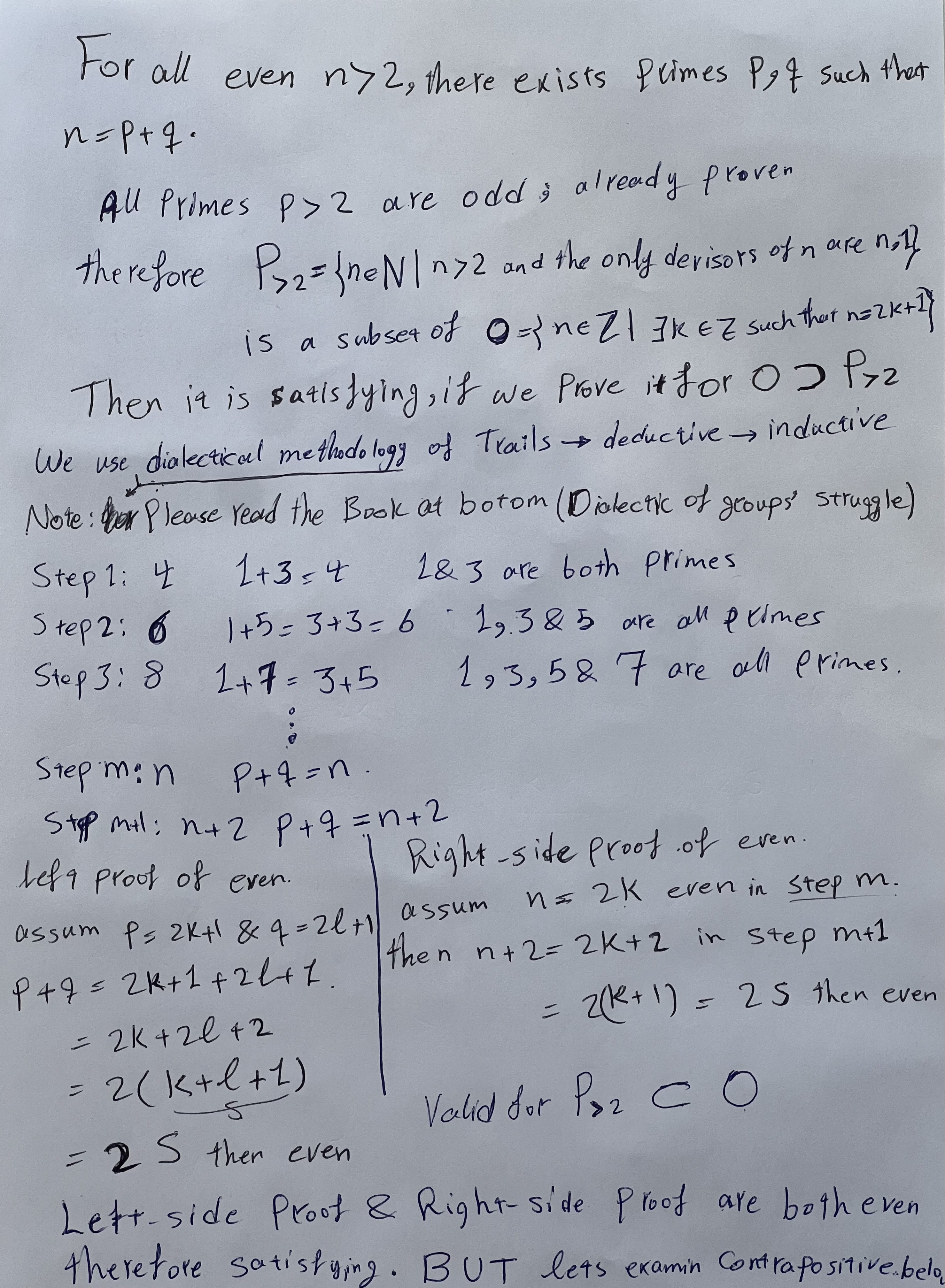
For all even integers \(n > 2\), there exist prime numbers \(p, q\) such that \(n = p + q\).
Setup & Definitions
All primes \(p > 2\) are odd (already proven by mathmaticians). Therefore:
Note that \(\mathbb{N}\) is a subset of \(\mathbb{Z}\) and it can be substituted by \(\mathbb{N}\) above, but by division I got even numbers from \(\mathbb{Z}\).
Then it is satisfying if we prove it for \(O \supset P_{>2}\). We use the dialectical methodology: Trails → Deductive → Inductive.
Empirical Trails
Step 1: \(n = 4 \Rightarrow 1 + 3 = 4\) (1 and 3 are both primes)
Step 2: \(n = 6 \Rightarrow 1 + 5 = 3 + 3 = 6\) (1, 3, 5 are all primes)
Step 3: \(n = 8 \Rightarrow 1 + 7 = 3 + 5 = 8\) (1, 3, 5, 7 are all primes)
…
Step m: \(n \Rightarrow p + q = n\)
Step m+1: \(n + 2 \Rightarrow p + q = n + 2\)
Left-Side Proof (Even)
Assume \(p = 2k + 1\) and \(q = 2l + 1\) (odd primes):
Right-Side Proof (Even)
Assume \(n = 2K\) is even at step \(m\). Then at step \(m+1\):
Valid for \(P_{>2} \subset O\). Both left-side and right-side proofs of the equation are even (Note: we already knew that both sides are equal but only needed to proof even), therefore satisfying.
Part II: Contrapositive of Goldbach's Conjecture as a New Theorem
Theorem
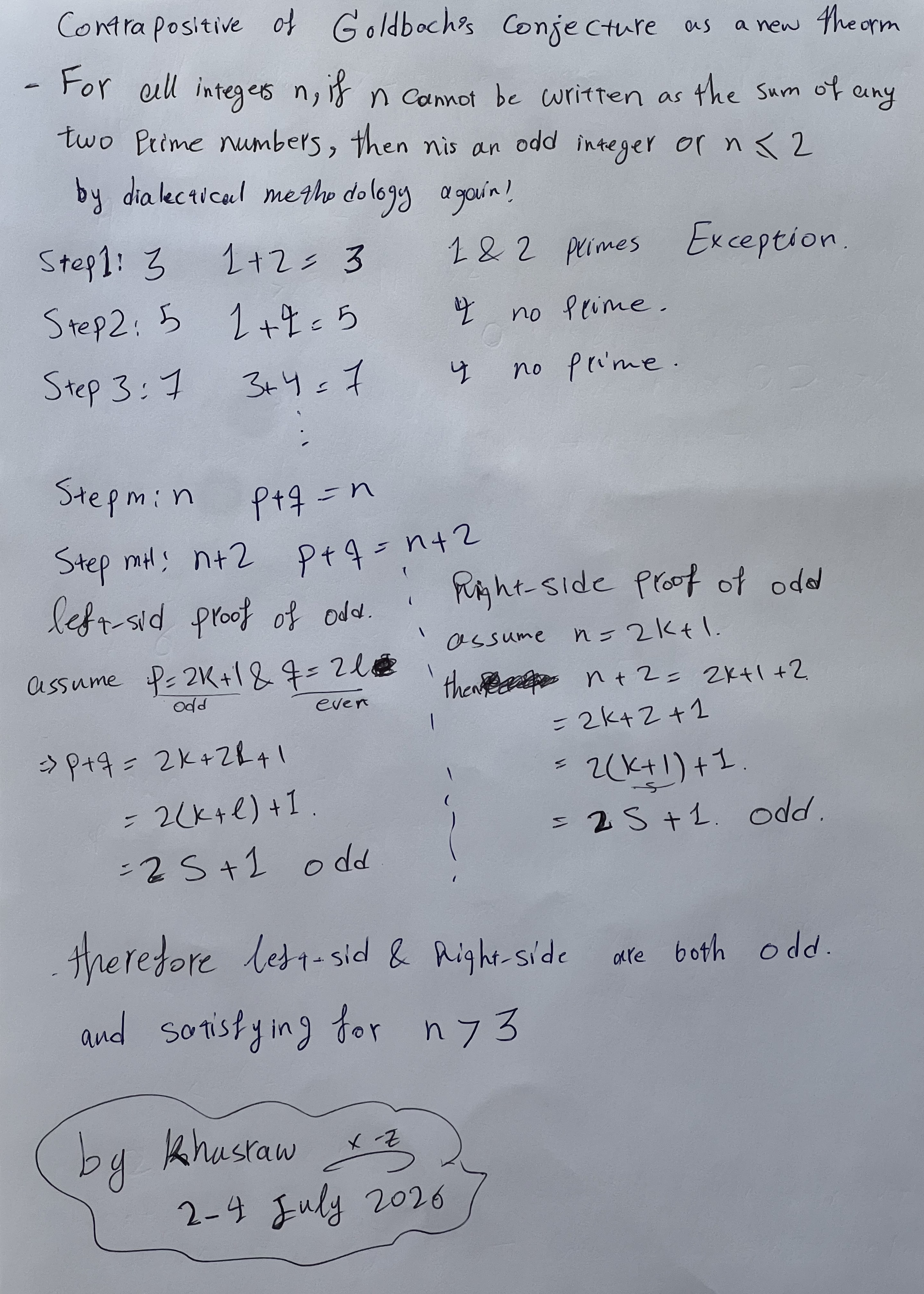
For all integers \(n\), if \(n\) cannot be written as the sum of any two prime numbers, then \(n\) is an odd integer or \(n \le 2\).
Empirical Trails
Step 1: \(n = 3 \Rightarrow 1 + 2 = 3\) (1 and 2 are primes — Exception)
Step 2: \(n = 5 \Rightarrow 1 + 4 = 5\) (4 is not prime)
Step 3: \(n = 7 \Rightarrow 3 + 4 = 7\) (4 is not prime)
…
Step m: \(n \Rightarrow p + q = n\)
Step m+1: \(n + 2 \Rightarrow p + q = n + 2\)
Left-Side Proof (Odd)
Assume \(p = 2k + 1\) (odd) and \(q = 2l\) (even):
Right-Side Proof (Odd)
Assume \(n = 2K + 1\) (odd). Then at step \(m+1\):
Therefore, left-side and right-side proofs are both odd (Note: we already knew that both sides are equal but only needed to proof odd), therefore satisfying and valid for \(n > 3\).