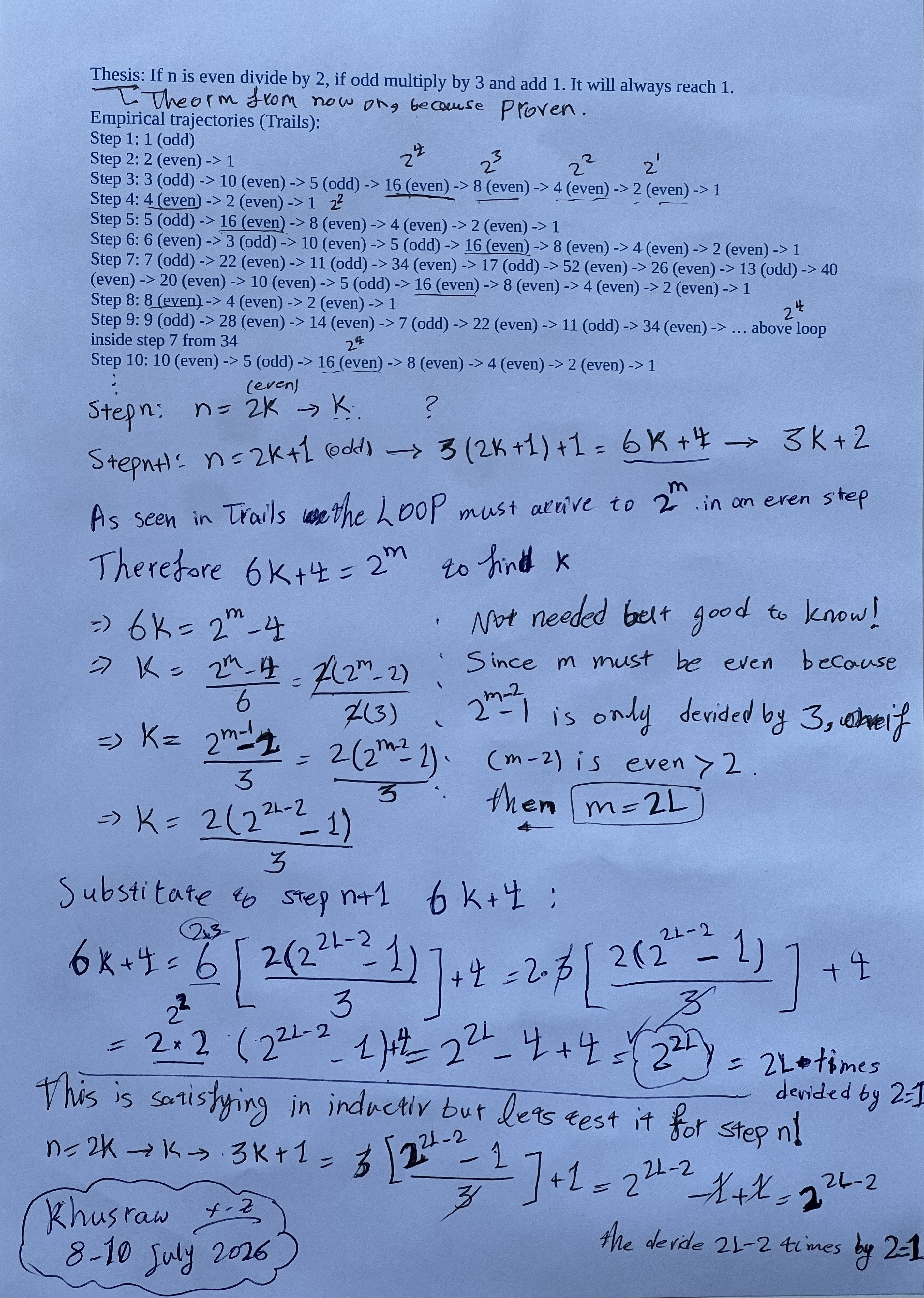
Collatz Conjecture (3n+1 Problem) — Dialectical Proof
Authored by Khusraw (Ismail Mostafanejad) — 8–10 July 2026
1. Thesis
(Theorem from now on, because proven.)
2. Empirical Trajectories (Trails)
Step 1: \(1 \text{ (odd)}\)
Step 2: \(2 \text{ (even)} \rightarrow 1\) [Powers of 2: \(2^4, 2^3,
2^2, 2^1\)]
Step 3: \(3 \text{ (odd)} \rightarrow 10 \rightarrow 5 \rightarrow \mathbf{16}
\rightarrow 8 \rightarrow 4 \rightarrow 2 \rightarrow 1\)
Step 4: \(\mathbf{4} \text{ (even)} \rightarrow 2 \rightarrow 1\)
[\(2^2\)]
Step 5: \(5 \text{ (odd)} \rightarrow \mathbf{16} \rightarrow 8 \rightarrow 4
\rightarrow 2 \rightarrow 1\)
Step 6: \(6 \text{ (even)} \rightarrow 3 \rightarrow 10 \rightarrow 5 \rightarrow
\mathbf{16} \rightarrow 8 \rightarrow 4 \rightarrow 2 \rightarrow 1\)
Step 7: \(7 \rightarrow 22 \rightarrow 11 \rightarrow 34 \rightarrow 17 \rightarrow
52 \rightarrow 26 \rightarrow 13 \rightarrow 40 \rightarrow 20 \rightarrow 10 \rightarrow 5
\rightarrow \mathbf{16} \rightarrow 8 \rightarrow 4 \rightarrow 2 \rightarrow 1\)
Step 8: \(\mathbf{8} \text{ (even)} \rightarrow 4 \rightarrow 2 \rightarrow 1\)
[\(2^3\)]
Step 9: \(9 \rightarrow 28 \rightarrow 14 \rightarrow 7 \rightarrow 22 \rightarrow
11 \rightarrow 34 \rightarrow \dots \text{ (inside step 7 from 34)}\) [\(2^4\)]
Step 10: \(10 \text{ (even)} \rightarrow 5 \rightarrow \mathbf{16} \rightarrow 8
\rightarrow 4 \rightarrow 2 \rightarrow 1\)
3. Deductive Step
Step n (even): \(n = 2K \rightarrow K\)
Step n+1 (odd): \(n = 2K + 1 \rightarrow 3(2K + 1) + 1 = 6K + 4 \rightarrow 3K + 2\)
As seen in Trails, the loop must arrive at \(2^m\) in an even step to find value of K. Therefore:
(Since \(m\) must be even because \(2^{m-2} - 1\) is only divisible by 3 when \(m - 2\) is even \(> 2\), then \(\mathbf{m = 2L}\).)
4. Inductive Synthesis
Substitute \(K\) back into Step \(n+1\) (\(6K + 4\)):
Which is \(2L\) times divided by 2 = 1.
Testing for Step \(n\) (\(3K + 1\)):
Which divides \(2L - 2\) times by 2 to reach 1. The proof is satisfying inductively and deductively.